A Second Opinion on the Second Apron
I recently had a friendly back-and-forth on the second apron and whether OKC should or will move Lu Dort in order to duck it with Ankit Patanaik.
The crux is this: Dort's current title and trade equity vs. OKC's current and future flexibility. Should OKC the Thunder ignore the second apron if it means keeping talent that hasn't yet been ejected from the playoff rotation? Or should they move on from a player on the decline as the younger, cheaper roster pieces continue to supplant his role?
I think I'm in the minority among Thunder fans and media. My take: I feel like we would be fine if OKCtraded a 2034 first rounder to acquire a title-helping player today, but fans are too worried about devaluing a pick in the same range to keep a title-helping player today. There's a lot of wonky cap nerdery involved in the debate, but I'm on the classic win-now side: picks in 2034 and beyond will be "burning a hole in my pocket during Shai’s peak."
 craymondfelton
Ankit is more aligned with popular online sentiment. His take: The cost of voluntarily staying over the second apron isn't justified for a player without more value than Dort. “Dort hasn’t been good enough to warrant this sacrifice.” He also notes that the downside isn't just long-term: the pick won't convey until 2034, but it could constrain OKC's other deal-making needs as soon as next year, since it will already be tentatively frozen.
Ankit gave me permission to post some excerpts from his Substack series on Thunder cap management. There's lots of good information that serves the reader and his counter argument well.
Excerpt: "The New CBA for Dummies"
by Ankit Patanaik
Cap Management
The biggest change is the addition of a “Second Apron”.
The First Apron acts much the same as the existing Apron in the old CBA, however teams will no longer be able to sign players who were bought out and had a salary greater than the Non-Taxpayer Mid-Level Exception. This would have prevented the LA Clippers from signing players like Russell Westbrook who was bought out of his max contract by Utah.
The Second Apron is a number that will exist at $17,500,000 higher than the Tax Level. For the 2023-2024 season, that number will be $182,500,000. If a team crosses the Second Apron, they will be subject to the following penalties:
- Unable to use the Taxpayer Mid-Level Exception.
- Unable to sign and trade to acquire players
- Unable to use Trade Exceptions to acquire players
- Unable to send cash in trades
- Unable to take in more salary than they send out in a trade
- Unable to trade their First Round Pick 7 years in the future. This pick in the future is called a “frozen pick”. Due to the Stepien Rule, a team can send at most 3 of its FRP’s along with 3 pick swaps rather than 4 FRP’s and 3 picks swaps.
- If a team is beyond the Second Apron in two years within a 4 year window, their frozen pick is sent to the end of the First Round regardless of their record. This would mean that a team would pick at #30 in the First Round of the draft even if they had the worst record in the league. The pick will be unfrozen if the team is under the Second Apron for 3 consecutive years after its freezing.
What does this mean for OKC?
Second Apron Boogeyman
This brings me to the next logical question: how will the Thunder pay for 4 max contracts with the Second Apron?
I’m of the opinion that OKC will simply pay SGA, Giddey, Williams and Holmgren when the time comes. Here are some reasons why I think OKC will be able to and how the New CBA makes it easier to do that:
- When it comes to paying the Luxury Tax itself, OKC has been committed to retaining talent at any price post-2014 if there is a chance to contend. OKC has been one of the highest contributors to the Luxury Tax in the years that we have attempted to be contenders. I think the current group has a significantly higher ceiling than any team OKC has had since the Durant+Westbrook days.
- Even though we are subject to the same restrictions as other teams, tougher restrictions on excessive spending make it harder for other teams to poach our talent because other teams are also trying to navigate the Second Apron. Less competition is better for all teams, including the Thunder, to retain their talent because they maintain their rookie’s Bird Rights.
- The removal of Rookie Designations and the ability to give 5 year Rookie Extensions to any rookie gives OKC increased financial capability to keep them here. I think there’s a high likelihood that not all of the Core Four will receive max contracts, though I think they will be really close. The Fifth year of control on a player’s contract was a huge reason why teams were willing to offer Max Deals to non-All Star level players.
- The Second Apron penalties apply when a team is at the Second Apron for the second time in four years. Presti (along with most GM’s) will be smart about when they think they can dip their toes past the Apron to go “all in” one year and move salary around in the following year to try and limit.
- On the specific penalties:
- OKC has never been a big free agency destination and has rarely made big, blockbuster trades sending out a ton of value to acquire players. As a result I don’t think the limitations around utilizing exceptions and salary in vs out will matter too much.
- Not being able to trade a teams’s draft pick 7 years in the future will sting a bit, but OKC owns 35 picks (15 FRP, 20 SRP) of which only 1 is OKC’s 7 years in the future.
- Having a team’s Frozen First Round draft pick pushed to the end of the First Round will hurt any potential rebuild in the future, especially if the Thunder have not been able to win a ring in the years leading up to it! There’s not really much of a silver lining here unfortunately 😢.
 Ankit Patanaik
Excerpt: Cap Management Pt. 1
The Second Apron
This is the major constraint by which I believe the Thunder have to be judicious about their spending. It sounds very scary and a lot of people online make it out to be a boogeyman of sorts — and yeah it makes things difficult, but with good planning, foresight and a little bit of luck, it seems more than manageable in my eyes.
What immediately sticks out with respect to the Second Apron is that we exceed the 2nd apron for the first time in 26-27 by $22,828,750 and then again in 27-28 by $21,598,218, thus incurring the strictest penalties around future draft picks. These numbers seem pretty big (and they are to normal people with normal jobs) but a $20-25 million dollar contract in today’s NBA is roughly equivalent to a solid NBA starter. This leads me to see a couple paths forward:
Option 1: Keep Hartenstein in 2026-2027 and shed depth in 2027-2028
This option would mean that the Thunder pick up Hartenstein’s team option for 26-27 and bring back every core player of the 24-25 championship-winning squad for a 3rd consecutive season. I believe this team with Hartenstein is likely the best option to win a title again, and we have the fortunate opportunity to bring it back for not just one but two more playoff runs.
However, all good things come to an end, and the second apron will become a problem in 27-28 as we enter it for the 2nd time in 2 years...
 Ankit Patanaik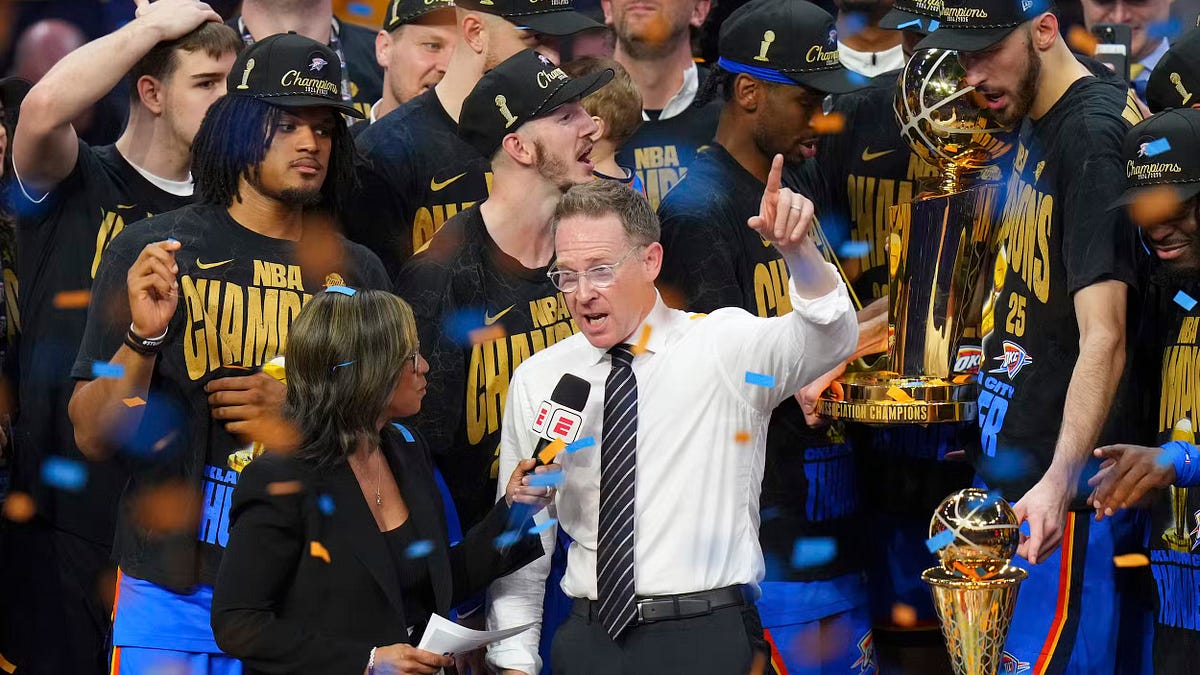
Excerpt: Cap Management Pt. 2
How do we make it all work?
The Cason Wallace extension doesn’t affect the Thunder’s cap sheet in 26-27, so I’m not gonna focus much on it. Cason is an incredible player who fills a crucial role for the Thunder as a point attack defender that can dribble, pass and shoot. He’s not going anywhere, and his contract extension is well deserved.
Trades (taking players back)
Based on cap reasons, it seems incredibly unlikely to make a trade this summer because the Thunder are deeply committed to the team with Shai, JDub and Chet as their core trio, surrounded by elite role players in Alex Caruso, Isaiah Hartenstein and Cason Wallace. The cheap depth rounding out the rest of the roster seems incredibly hard to get better bang for buck on while simultaneously making it hard to match salaries for a player with a significant contract.
 Ankit Patanaik