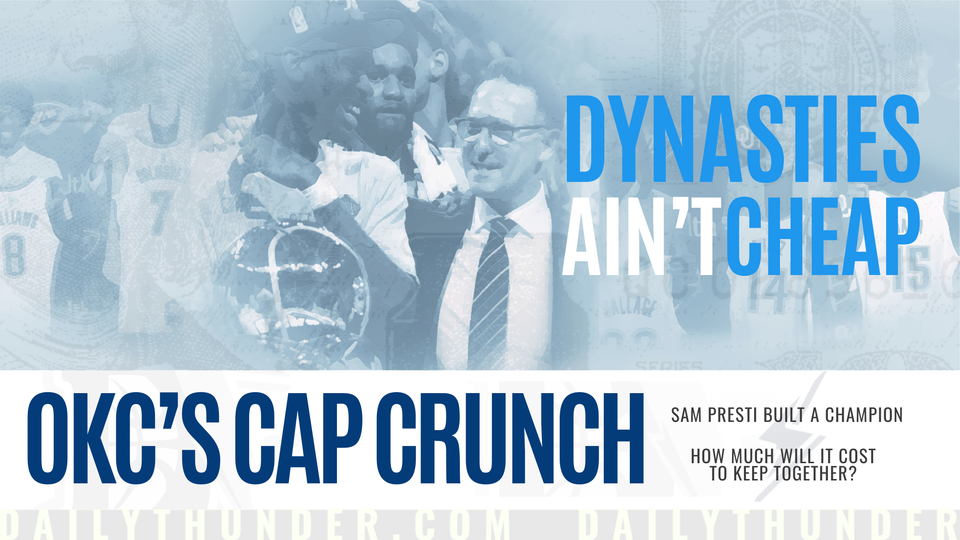
Dynasties Ain't Cheap: OKC's Cap Crunch
For most of last regular season and playoffs, Jalen Williams missed playing basketball, and the Thunder missed him. I'm no multimillionaire star athlete, but I'm guessing it's annoying to follow up a title run by watching your own chances at rookie max incentives and your team's chances at a repeat slip away from the sidelines.
After risking his health in a gritty, heroic run last postseason, JDub's lost season of rehabbing, returning to the court, re-injuring, resting, and ultimately shutting down before OKC's fateful Game 7, added up to a very limited 42 total appearances in 2025-26. He lost the opportunity to trigger Rose Rule escalators on his contract while his team fell just short of the chance to defend the Thunder's 2025 championship in the Finals, without him.
I'm also not a member of an entity that will owe north of a billion dollars in taxes to pay for a long stretch of dominant Thunder basketball, but I have happily advocated for such a group to pick up that tab. This team is worth it; dodging taxes to support its flourishing would be a massive disappointment.
You may assume I'm talking about the Oklahoma City Thunder ownership group, but I'm actually referring to Oklahoma City residents. The good people of Oklahoma ponied up over $120 million in arena renovations to draw in the Thunder over the team's inaugural three year stretch back in 2008-2010, and they have already put themselves on the hook for another $1-1.25 billion from 2020-2034.
The Cap Crunch
I buried everyone else's led: OKC's ownership will also owe a billion dollars or more in cumulative luxury taxes to the NBA if they keep most of the championship gang together for the duration of Shai Gilgeous-Alexander's prime. As JDub's max extension kicks in alongside Chet Holmgren's next season, the Thunder's very first tax obligations for the current championship era will come with it. Each decision will come at a cost to both the on-court product and the out-of-pocket expenses for team ownership. The Thunder fan base is bracing for the team to shed many more millions as the team's payroll soars within the new, harsh CBA. We know all too well how a team built into a contender can get squeezed by financial forces within and outside of the franchise's control.
In the first moves of Oklahoma City's offseason, Aaron Wiggins was shipped out for second rounders. Then, all three of OKC's draft picks were spent on positions crowded by veterans (center and guard). Next up was Isaiah Joe: traded for more picks. Were these simply value plays for vets who had fallen out of the postseason rotation, and swings for prospects who fell into OKC's lap? Or were these the first dominoes to fall in a more aggressive effort to replace key players with cheaper, younger assets?
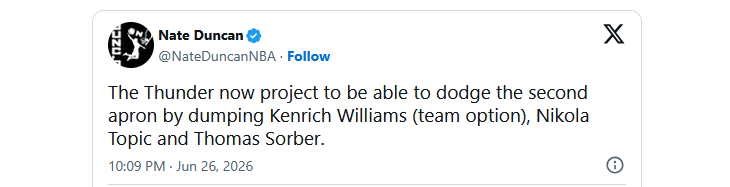
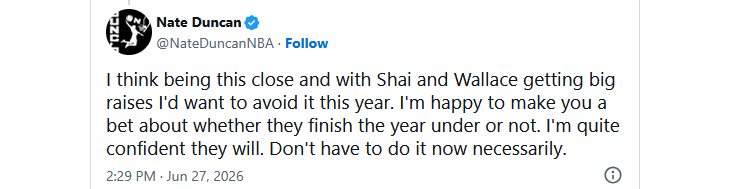
It's not just fans feeling gloomy about the Thunder's roster. Cap expert Nate Duncan agrees with team building genius James Dolan that the second apron must be avoided at all costs, even for a championship roster. Duncan suggested that dumping veteran and rookie scale contracts are a likelihood if it means (barely) ducking the second apron.
The news of Isaiah Hartenstein's re-signing was the first affirmation that a teardown is not underway. Expect more of the sort. The front office has two days left to exercise or decline team options for Lu Dort ($17.7MM) and Kenrich Williams ($7.2MM) next season. They have until October to extend Cason Wallace and exercise rookie-scale options for Jared McCain, Nikola Topic, and Thomas Sorber for 2027-28 and beyond. There should be much more staying than going in Thunder news breaks ahead.
As is his custom, Excecutive VP & GM Sam Presti has been both transparent and non-committal about the Thunder's designs for the future. Last year, he addressed cap ramifications ahead for a franchise that would now be looking to keep a championship roster together for the first time in its history. When asked about the looming pressures for OKC–a brutal repeater tax, and first and second aprons meant to freeze expensive teams out of getting better–Presti reminisced on how cap changes had worked against the Thunder in the past. But rather than projecting doom and gloom, he noted:
“As constituted right now, we wouldn't face repeater penalties until the next CBA.” - Sam Presti, 6/30/25
As is its custom, the internet reduced Presti's remarks to a guarantee that Oklahoma City would soon be ducking taxes to save money and preserve flexibility. But maneuverability is not the issue. Presti addressed the same dynamics again last fall, declining to pin any potential roster changes on the transaction limitations forced on apron teams:
“The rules themselves are not prohibitive to our ability to maintain the team. The challenge is obviously...the finances that come with that.” - Sam Presti, 9/25/25
The restrictive aprons do not prevent OKC from maintaining the deepest contender in the league. The aprons prevent the Steve Ballmers and Joe Lacobs of the NBA from acquiring a mountain of expensive talent like the Yankees and Dodgers of the MLB, but they can't break up what the Thunder already have.
Reminder: if a team ducks under the second apron, they can't make moves that would put them back over it. For a deep, young team with 16 players under team control (17, if we count last year's second rounder Brooks Barnhizer) and zero negative assets, it's hard to imagine a single deal under the first or second apron that would be better for the Thunder than simply keeping the best players they already have. The earliest material hit to OKC's asset stash will come in 2029 if they stay over the second apron for three of the next five seasons. Their own draft pick would be locked in at #30 at that point, the same spot it's been occupying the last two seasons.
The escalating tax penalties are much more punitive to the owner's back pocket than they are to a GM's ability to manage the roster. There is no real benefit for a stacked team disassembling its way under the aprons–but there is benefit for owners convincing fans that they need to cheap out on the roster in the name of maintaining cap flexibility.
Thankfully, Executive VP & GM Sam Presti hasn't tried to sell us that bill of goods.
Oklahoma City has always been explicit about their disadvantages as a small-market team, but they have never cried poor. The “cheap” label has always come from fans at home and abroad. In fact, OKC already paid a hefty tax bill after promising to do so throughout the final stretch of Russell Westbrook's Thunder career. When KD left, many of the same assumptions about the owners and the cost of keeping a team in Oklahoma City were in the ether: Would they race into a rebuild? Max Westbrook and dump the rest? Sell the team altogether? Instead, they shoveled more money into the roster for as long as they could plausibly contend around their MVP. OKC's owners made good on the investment fans and players had shared to get them there, ultimately paying $150 million in luxury and repeater taxes for the team through 2019.
That final stretch bought three first-round playoff exits to pair with Russ's incredible career crescendo. If that team was worth it, Shai's squad is more so.
Power Players
Now, OKC has exactly the kind of roster a market spends a decade trying to earn the right to overpay. They are a recent champion that was barely unseated when severely injured. OKC got here young, pre-tax.
Speaking of Ballmer and Lacob, one of the ironies of the big-vs.-small-market power shifts from the last decade is that the have nots in OKC are suddenly in a position to operate like the haves to maintain this position of strength—with less relative financial pain and risk for Thunder ownership to endure than their big spending predecessors.
OKC's windfall from the Paul George/Kawhi Leonard brew of confirmed and alleged tampering and cap-subversion antics laid the foundation for the deepest contender of the era. And now that Clay Bennett and the other governors are facing down a massive, multi-year tax bill for an established championship team, the tab is relatively lighter than the Lacobs picked up for rosters that were much older and much less capable of stacking championships.
Presti leveraged LA's greed and outsmarted the league en masse as he put together a championship roster that won the whole thing while employing the following players:
- One max, MVP player, aged 26
- Two role players aged 26 and 30
- Six more players between the ages of 22 and 25
These 9 core players were all leaned on for heavy minutes in the 2025 title run and/or the 2026 Western Conference Finals, and all are still under team control through at least next season:
- Shai Gilgeous Alexander
- Isaiah Hartenstein and Alex Caruso
- Jalen Williams, Chet Holmgren, Cason Wallace, Ajay Mitchell, Lu Dort, and Jaylin Williams
On top of these championship producers, OKC has five top-16 picks—Aday Mara, Topic, Sorber, McCain, and Bennett Stirtz—to compete for more long-term slots. We're up to 14 players before we even mention Kenrich Williams or several more draft picks in hand for the next three seasons.
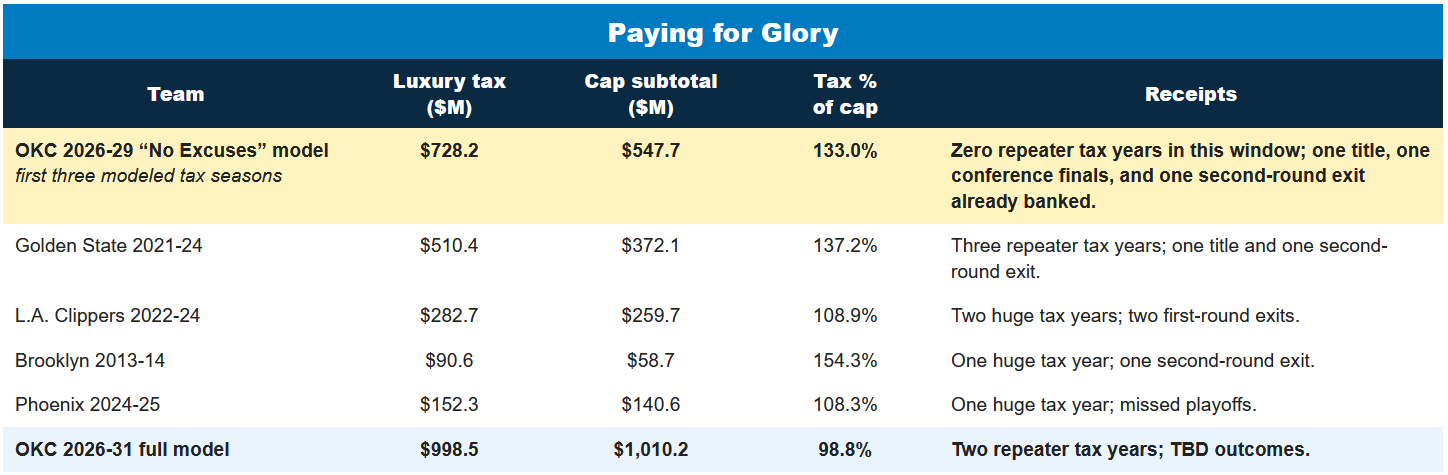
Most teams pay the bill while aging out of contention. In the closest analog of destiny and taxes to the current Thunder, the 2021-2024 Warriors paid to do right by Steph, Klay, and Draymond in their early-to-mid thirties while the walls closed in on their championship window:
The Thunder are a dream team, the kind of roster Ballmer would pay $8 billion to transfer to Los Angeles. OKC climbed the mountain with a deep, young roster, two years before the tax line started to matter. OKC isn't trying to crack open a championship window or stave off its closing. They're paying to keep theirs wide open. Take it from Presti:
You do want to be in this situation. As I said, we have 15 players that we really like, all under contract for next season. And it's not a theoretical team in the sense that we've demonstrated we can win at a high level. Our margin of victory over the last three years is among the highest, along with the Golden State team that had Durant...and then also some of the Bulls teams. - Sam Presti, 6/8/26
 Daily Thunder Staff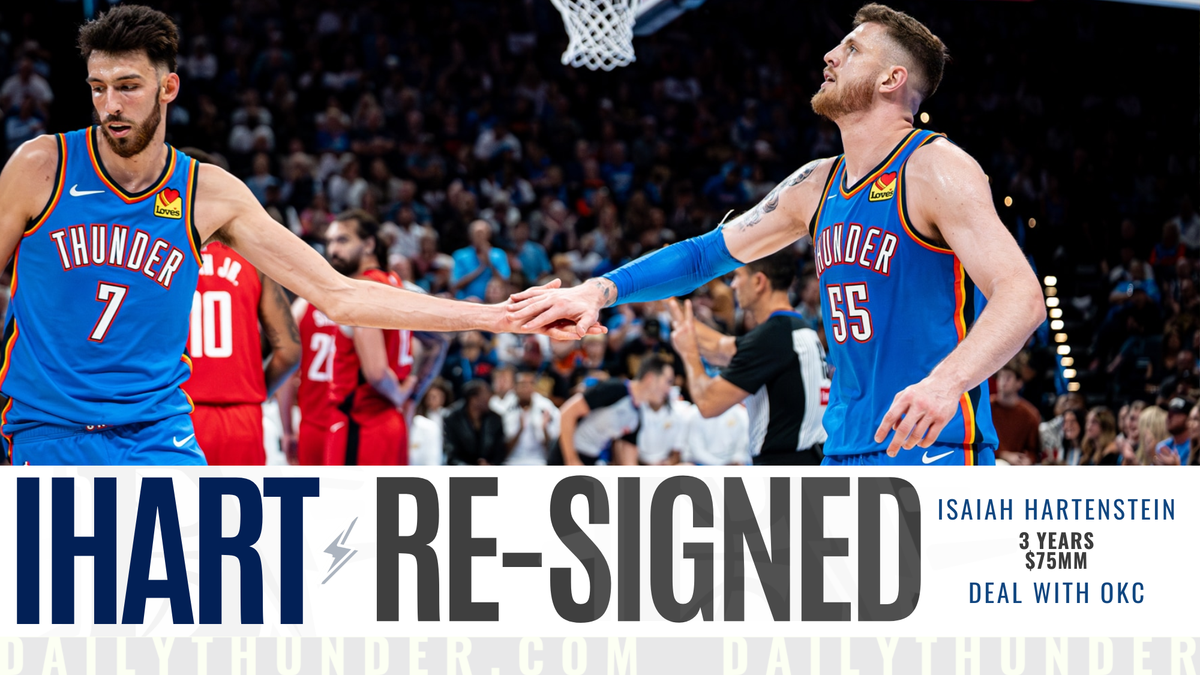
No Excuses: The Next Three Years
There is simply no reason to let go of any of those 9 players I highlighted above.
One thing I insist on from the reader: Just like we've had to retrain ourselves to think of player contracts as a percentage of the ever-increasing cap, we must do the same for tax penalties. A $150 million tax bill is enormous, but so is $330 million in Basketball Related Income (BRI) it's scaled from annually. Thinking of the tax as a percentage of the cap, just as we do salaries, is the best way to assess the true cost of OKC's financial future.
That projected three-year bill is approximately $728 million, about 133% of cumulative salary cap in the same span. Golden State's 2021-24 run racked up about about $510 million in taxes, closer to 137% of their cumulative salary cap. The Thunder would pay more raw dollars in the expanded NBA economy, but it would be less proportionally than the Warriors did relative to BRI.
Presti noted that OKC will not pay the repeater tax until the CBA is up for renegotiation in 2029. In the model below, Oklahoma City keeps the gang together while paying the ordinary luxury tax in 2026-27, 2027-28, and 2028-29–before the multiplying repeater penalty starts turning the screws.
This is not an optimistic model for the Thunder's cap or players. This is about as expensive as continuity could get. The core stays intact, with deals priced in around recent market value for the players involved. I've gradually filled the bottom of the roster with ordinary, cheap labor. They could be a little cheaper or a little more expensive than this by staying the course, but not radically so.
OKC would only exceed Golden State's peak annual tax-to-cap number once, in 2027-28. The rest of the stretch is expensive, but not unprecedented in proportion to the league's own cap scale. The Suns, Nets, and Clippers have all paid through the nose for hail mary seasons that didn't work out. If OKC didn't make the playoffs in the next three years, they'd still have more to show for this stretch than any of these historic comps did. If they added a conference finals, a Finals berth, or another title, they'd have a bargain on their hands.
 craymondfelton
And the model is still very forgiving, only spending one first- and second-round pick on a roster spot per year. Oklahoma City has a lot more draft optionality than that. But if they keep an abundance of picks, they don't have to turn them all into cheap, quality players. They can also be used as trade sweetener if and when they need to get off of deal that gets too burdensome. For example: I wouldn't advocate for this in the "no excuse" zone, but I could understand if Alex Caruso was deemed to expensive and too old in that peak 2027-28 season. Swapping him plus a pick for a player on their rookie scale at the deadline would save OKC about $223.6 million in taxes the rest of the way, and drop their overall tax % of the cap for the entire stretch down to about 82%. Bargains everywhere!
Buying Time (What About Lu?)
There is plenty of time for the Thunder to shed salary and duck taxes if and when the team stops meriting this price tag. The final payroll numbers at the end of the season–not the beginning–are what determines a team's actual tax obligation. It would be inexcusable to pre-emptively become less competitive before we see whether the team that opened last season 24-1 is still a heavyweight. OKC can enter each new cap year with a big bill, and still have the ability to duck down at the trade deadline like every other tax-averse franchise does.
In taking up Duncan's earlier bet, I posited the Dort question as the only legitimate apron variable. If OKC and Dort can't align on a contract and roster fit next year or beyond, shedding his salary number for picks and/or minimal salary would dip the Thunder under the second apron for next season. Under current projections1, the Thunder would have less than $2 million of room under the second apron if they emptied Dort's contract slot outright. That would leave OKC at 14 of 15 rostered players allowed for the season, and only some creative timing and/or adjusted cap numbers from the league would make it possible to fill the 15th slot with the cheapest talent in the league. As Sam Quinn points out, these complex actions would delay the inevitable: several years to come of cap and tax restrictions for the Thunder.
If Dort holds enough value to fetch an established veteran wing, that's a much more attractive win-now asset swap to make. Staying as loaded as possible in a quest for the 2027 title during a precious prime-Shai year is more important to me than stalling a #30 pick from freezing in 2029 instead of 2030. As we discussed on the most recent podcast, keeping Dort around for part or all of this season might make the rotation very tricky, but it would still keep a known quantity in hand until OKC knew that other improvements within the roster could supplant it (Dort played 19.3 minutes per game in the Western Conference Finals, just 1.6 minutes fewer than Hartenstein).
But beyond the in-season timing, the real fork in the road is not until 2029-30, when the repeater tax finally kicks in. There are no excuses for ducking the ordinary tax in the three seasons until then. The summer of 2029 is when legitimate decisions about players who can still contribute–Alex Caruso expiring at age 35, Sorber and/or Topic entering their first extension years–should be made.
We have had ample time to prepare for this. - Sam Presti, 6/8/26
The Thunder decision-makers have a lot more models than I do2. Their sheets will include many other factors–revenue and liabilities outside of the cap set by BRI3. If they're doing an honest assessment of ROI, they know that there is a reset and retool window that won't disappear. That window is the 2029-30 season, the one Presti circled as the inaugural repeater-tax year, and beyond. That's when we could see truly eye-popping numbers as extensions for Sorber, Topic, Mara, and Stirtz kick in.
Assuming positive outcomes for those players, they could demand deals in the neighborhood of $20-40 million. But if they're producing at a high level for Oklahoma City, that means the championship core might be even more unprecedented. There are more extreme possibilities as well. If any of those rookies demand a max extension, OKC could not sign them to such a contract while Holmgren and Williams occupy the only two designated rookie max slots the NBA allows. If they aren't very good, those annual figures, or the obligation to extend them at all, will deflate.
But the Thunder do not have to decide in 2026 whether every young player is worth his 2030 price. They do not have to decide whether every veteran will be at the top of the rotation four years from now. They can pay for three more clean shots at the trophy, then choose whether they should preserve a real, costly dynasty or start changing the composition of a team that has failed to become one.
Cashing Out
Modest cap maneuverability isn't the only relief on the horizon. If things go really poorly by that 2029-30 fork in the road, OKC could even hit the nuclear button on another aggressive rebuild. Trade Shai and/or JDub and/or Chet, harvest a monster rebuild package, and drop out of the tax zone altogether. Again, this would all be possible before the first penny of repeater taxes are ever billed to the business office.
And then there's the real nuclear option. Since its first tax bill in 2015, the team's overall value has quadrupled to over $4 billion today. If ownership can't afford to own a team because of tax payments in the hundred of millions, someone else will happy to take it off their hands for thousands of millions.
Any way you look at it, the choice is simple: Pay for the team while it's special. Thanks to Presti's work4, this roster is in no danger of becoming too expensive without an off-ramp.
In This Together
Jalen Williams has already paid a real price for this timeline, and so have his Oklahoma City neighbors.
The difference between JDub's actual 25% max line and the 30% rate he could have earned is about $47.9 million. Because every Thunder dollar in this stretch is a multiplied, his loss will have saved the owners about $200MM in tax payments over the next three seasons.
The Oklahoma City taxpayer has already saved ownership a pretty penny for a new arena to play ball in the modern era, committing well over a billion dollars to house the title team in its old and new digs through 2034. Ballmer and Lacob privately financed their new arenas for blockbuster teams on the west coast.
We want to keep it going as long as we can. - Sam Presti, 6/8/26
The Thunder can keep these young, excellent players together for a long time, if they want to. They can pay like the Yankees to see if it buys them an actual dynasty. They can wait to trim at the margins or reset in a few years. They can prop up the team while it's special, and blow it up if it's not.
They can afford to keep the Thunder machine at full throttle. Thankfully, they appear willing to keep pressing the gas pedal.
Footnotes
- The NBA's final cap numbers for 2026-27 are net yet official, but the league has shared a projection that should be very close.
- I must admit, trying to make a reliable interactive spreadsheet of the Thunder's cap structure for several years out was humbling. I live and breathe spreadsheets and budgets as a professional and a hobbyist, but modeling salaries and tax lines–all of which are very easy to find as raw data–against the unknown cap future is quite the tight rope. Business analysts working for NBA teams no doubt are factoring in good years, bad years, pandemic years, etc. into their revenue and payroll models for the on-court product. It's far-fetched, but a bearish cap stretch for the NBA could turn painful luxury tax payments into crushing albatrosses. Were that to happen, teams in OKC's position would have to dump draft capital into desperate fire sales that would make Thomas Dundon look generous.
- There is no apples to apples way to really compare these kind of ownership and arena-revenue assets from team to time (the Warriors and Knicks rake in over a half billion annually thanks to privately financing their own arenas, while Memphis makes nothing), but OKC does just fine for a small market team. Their lease payments and gate revenue net out to better than average, and their bottom dollar operating income (estimated at $114 million annually) is about twice the average league-wide.
- I'm in the minority of those who think Shai Gilgeous-Alexander deserves to be afforded by his ownership as many Finals chances as Steph, MJ, Kobe, and the other legends did before him. Jerry Reinsdorf robbed Mike of more financial support while the Lacobs bled green to do right by Steph. And LeBron has created a wake of max salary and cap hell for every franchise on his path to 10 NBA Finals appearances. If you don't think of SGA in those terms? One might say that Sam Presti is the MJ of rebuilding. For the second time, Presti put together a young team that reached the Finals years before the tax man came around. Presti has the job of convincing owners to sign checks and, like all GMs, bears the public wrath for any cost-saving moves. Those tough choices are often shrewd in ways a fan can't be expected to reckon with–save the owner today, get their signature tomorrow. But he's stewarded of every penny they've invested in the team to their satisfaction, and it would be a shame for him to start managing the roster from a position of financial weakness now that it has ascended to these heights. Like fans, JDub, and Shai–who patiently stayed the course while the team assembled around him–Presti has built up capital with his bosses as well.