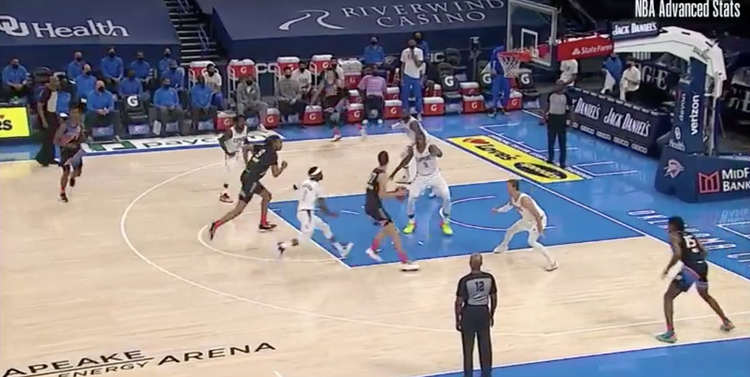
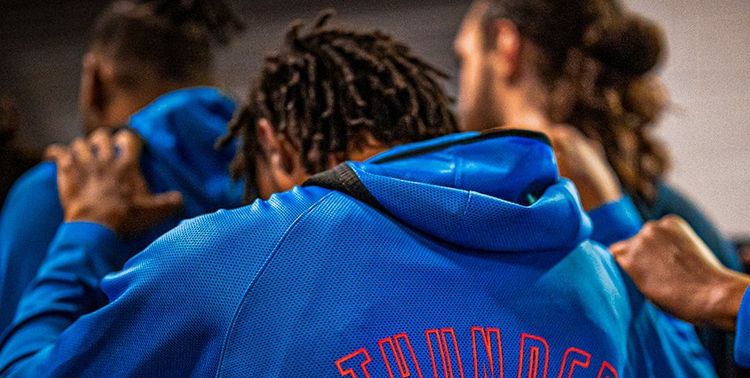
Lost in all this Russell Westbrook noise was that the Thunder did just enough in the last four minutes against Memphis to hold on for a really nice win. Which if you recall, was something of a chore during the playoffs last season.
In both the Dallas and Memphis series, Oklahoma City’s halfcourt sets basically devolved into Westbrook trying to force a pass to Kevin Durant while KD held off Shawn Marion for 18 seconds and then after that inevitably failed, Westbrook trying to create something on his own.
In the past, the Thunder have primarily run two sets: 1) Westbrook and Durant in a screen-and-roll/slip play on the wing and 2) KD isolating at the top of the key with Westbrook trying to feed the ball so KD can go one-on-one with his man.
In conclusion, didn’t work so great. The has been a lot of pressure on Scott Brooks and his staff to get more creative with his two stars and figure out what to do in those later stages. You want KD with the ball and taking the shot, but it’s complicated. There’s a reason Westbrook was forced to go rogue so much. You don’t think Brooks wanted KD taking those shots? Thing is, he’s got to get it in an area he can score and he’s got to get it somewhere we he doesn’t have to dribble a lot to get his own shot. Read more…
You know how some TV shows get disclaimers on them? Well, this post needs one too. This post may not be suitable for emotional Thunder fans still not over yesterday’s loss. Reader discretion is advised.
Following the Thunder’s incredible fourth quarter meltdown in Game 3 which gave away a big swing game, a lot of focus was on Russell Westbrook and his now infamous “hero mode.” I saw it differently. I didn’t think Westbrook had a whole lot to do with it. I saw it more as a product of bad team offense, no James Harden and predictable, elementary offensive sets. Westbrook was a part of it, but it’s not on him exclusively.
I don’t think me just saying it convinced everyone — not even myself necessarily — so I re-watched the Thunder’s fourth quarter again, specifically those last seven minutes. The video of every Thunder offensive possession the last seven minutes of the game is above. If you’re one of the many pinning this on Westbrook, you’re probably going to see what you want to see and I’m not going to change your mind. But going through it, I just don’t see how Westbrook went “hero” or tried to subvert Durant here. Read more…
I’ve really enjoyed not only the way Scott Brooks has found minutes for Daequan Cook by virtue of expanding to a 10-man rotation but even more so, how Cook has totally taken advantage of it.
Cook only sees 8-12 minutes a game typically (only five last night), but as OKC’s 3-point specialist, he’s ready to step on the floor and knock down shots when called upon. We could argue as to if Cook probably deserves a few more minutes a night, but point is, having a weapon like Cook in your second unit is pretty valuable.
Thing is, you’ve got to figure out exactly how to use him. Last night for example, Cook took two shots and went 2-2 (1-1) from 3. Exactly what you want from him. Underrated minutes. If he’s only going to sees four or five minutes, you’ve got to make sure he gets his shots. It’s very easy when you’re the third or fourth option on the floor to go those five minutes without getting a look. And Cook’s not on the floor just to stand around and play defense.
So Scott Brooks has developed a subtle play for Cook. I first noticed it about three weeks ago and now it looks like a set the Thunder runs routinely only with Cook in the game. Read more…
It’s become part of the Thunder game routine. Just like you can be sure Russell Westbrook will smack his hands together after a no-call at least once, just like you can know Kevin Durant will fall down a time or two in a way that scares you to death and just like you can be certain Nick Collison will take a charge, you can also be sure James Harden and Collison will hook up on a backdoor cut and pass.
Unofficially, I think they have a streak of 60 games on this. I can’t think of a night it didn’t happen honestly. It’s become a go-to set for the second unit and one with a success rate of somewhere around 99 percent.
So naturally, let’s study it in a little greater detail. In the video I put one backdoor play from the Charlotte game Friday and one from Sunday night’s game against Toronto. Read more…
When Kevin Durant’s game-tying 3-pointer dropped through the net with six seconds left in Philadelphia last night, a lot of people thought finally. Finally Scott Brooks drew up a play that worked at the end of the game. Finally Oklahoma City executed said play.
There has been lots of talk about the Thunder in these situations — not as much as the Heat, though — and a lot has centered around the plays Brooks’ clipboard. A lot of the criticism has been that there’s no creativity, that everything is too straightforward and simple.
But upon closer examination of Durant’s big 3, I wouldn’t say it was an ingenious playcall or anything. I wouldn’t say it even close to one of Brooks’ finer sets. Fact is, it worked and that’s what makes it good. I’ve always said about these last second shot situations is how when the ball goes through the net, it suddenly makes a set look really great. And when one clangs long, the play is crap. Read more…
One of my favorite basketball sayings comes via the always excellent Stan Van Gundy who said to write the story with the ball in the air. I heard that used for the first time by Tas Melas on a Basketball Jones episode recently and it made total sense to me. Too much sense.
And if you were doing that in Oklahoma City Saturday night, your story would’ve looked like this: Kevin Durant didn’t shoot well at all; the Thunder’s defense was absolutely awful; OKC’s offense was elementary against a poor defensive team; and really, the Thunder didn’t deserve to have a chance to win.
Except KD sunk a beautiful fade-away 3 and we all went home happy. Just like that Durant had a wonderful game, the sins of the first half were forgotten and the Thunder had just won a great game. Again, I love that quote.
But here’s the thing: Even the Thunder’s game-winning play kind of stunk. They didn’t execute properly and what OKC wound up with was a near impossible shot from 3-point range at the buzzer. So if you’re writing the story with the ball in the air, you’re probably saying something about how poor a shot the Thunder got at the end of regulation.
Regardless, it went down and it was a great player making a great player. But for fun, let’s break this baby down. Read more…
This was kind of the topic of discussion in Saturday’s game recap after Oklahoma City’s win over Denver, but I wanted to look a little more closely at Kevin Durant’s work out of the double-team.
Teams have been doubling KD on the catch when he’s posting as well as off the dribble. After his 21-point third quarter, the Nuggets were determined to get the ball out of Durant’s hands. OKC tried to isolate on the wing with Durant, relying on him to either distribute as the double came or score if it didn’t. It worked out pretty well for the Thunder down the stretch and really showcased some more maturity in KD’s ever evolving game. Read more…
The Thunder haven’t been good offensively so far this year. In fact, they’ve been bad. (How’s that for intelligent basketball analysis?) I don’t just mean statistically (last in assists and AST%), but just in a basketball sense. The offense has turned into an episode of Improv Everywhere. There’s no scheme. There’s no cohesion. It’s mostly one-on-one and a total reliance on shots going in.
Oklahoma City isn’t running an offense conducive to producing open looks or easy baskets. It’s an offense based on shot-making and while the Thunder has a bunch of talented offensive players, even the best ones don’t hit much higher than 45 percent of their attempts.
Not that the Thunder had an excellent offense last season because truthfully, the Thunder won mostly on the defensive end, but what’s the problem right now? Why does the Thunder go through stretches of four or five minutes without a basket? Why are they missing 11 straight from the field? Why are they scoring 37 points in a half? Let’s look at a number of possessions from the Celtics game Sunday night.
Play 1: Westbrook and Krstic pick-and-pop Read more…
It wasn’t exactly a highly anticipated debut like John Wall’s or Blake Griffin’s, but the Thunder’s top pick in last June’s draft made his first appearance Sunday night playing 11 minutes.
Cole Aldrich didn’t have a line that jumps out at you – five points, two rebounds – but in the small time on the floor, we got a pretty solid look at what he can add and why he caught Sam Presti’s eye.
Aldrich made an immediate impact on the game, loudly dunking an offensive rebound for his first NBA points. But in just a couple possessions, he greatly affected the Jazz offense with his length and instincts. Here are two possessions I thought were good examples:
I think we can all agree that Ron Artest did a terrific job on Kevin Durant yesterday. KD went just 7-24 from the floor and took eight 3-pointers, hitting only one. He took almost all jumpers, and never looked comfortable. A lot of it had to do with some visible nerves early in the game, but most of it was because of Artest just being a pest. He was disruptive in every way, pushing, pulling and grabbing Durant around every corner.
Here are five plays Durant was stopped and on the end, one successful trip down the floor.
OK, so let’s analyze a bit. The first play: Read more…
Hubie Brown hammered the Thunder last night for poor transition defense against the Grizzlies early on after Oklahoma City gave up four easy buckets. And he was right. Transition defense has become a bit of an achilles for the otherwise stout Thunder defense. Let’s watch the four easy transition buckets that came early.
To recap: O.J. Mayo scored on a runout layup, Mike Conley Jr. went to the rim with little resistance, Mayo went to the rim with little resistance and then Conley got back into the paint and to the rim. If you wanted to simplify three of those, it’s just that the Thunder didn’t stop the ball. It’s the number one rule of transition defense. Stop the ball, make the player pass. A pass gives your teammates a chance to recover and hopefully set up. But let’s look at it one by one. Read more…
The Thunder lost the kind of game last night that you lose sleep over. What if Kevin Durant had hit 2-4 from 3 instead of 1-4? What if George Hill doesn’t get “fouled” right before the half and awarded three free throws? What if James Harden were healthy? But you wouldn’t be asking yourself these mind-numbing questions had one shot not rimmed out. Thabo Sefolosha got a good look from 3 with eight seconds left, but just didn’t make it. And while “Thabo Sefolosha” and “last shot” typically don’t go hand-in-hand, Scott Brooks said after the game the play was executed well and KD made a good decision passing out of a double-team. So let’s have a good look at that final play, shall we? Read more…
We all know Oklahoma City has had some offensive issues this season. OKC ranks 20th in offensive efficiency (105.9), which is an improvement from last year where OKC finished ranked 29th (102.9). So it’s gotten better. But at times, the Thunder’s offensive execution can be extremely elementary. To be honest, the entire offensive scheme isn’t complicated. I would say it hinges on three general principles: 1) Get Kevin Durant the ball in a position to score 2) Create off a drive and score/kick out to a shooter and 3) Get Kevin Durant the ball in a position to score.
But in more than one circumstance, bad execution has cost them late in the fourth quarter. Kevin Arnovitz detailed some of this in far better fashion than I could, but I wanted to dip my toe in the water and take a closer look.
So against Denver, I wanted to highlight five different possessions, all from the second quarter (thanks to reader Johnny for the grabs). Let’s take a peek. Read more…
Let’s take another bite into some film, shall we? This time, we’re going to look at what changed for Kevin Durant between the first half (where he scored 20 points) and the second half and overtime (where he scored just eight) Wednesday night against the Lakers. Roll the video! (As always, big props to Johnny for the video. Check out the shiny arrows and commentary he added!)
If you can’t tell, I’m a little obsessed with the details of basketball. I like knowing how and why the other team scored, as well as my own. Anyway, James Harden caught some attention last Friday with his eight assist performance in Detroit. He’s also caught a little criticism for his supposed slow start to his rookie year. But I wanted to break out some video to show exactly what Harden brings to the floor and why he’s going to be an absolutely dynamic offensive player for the Thunder. He can score, don’t worry. That stuff will come. But lots of athletic guys can score. What Harden’s got is intelligence, an understanding of the game and the most important thing of all – this thing called feel.
(Big time thanks to reader Johnny for the video.)
Two assists stand out from that sequence more than any other. And they’re not even the flashiest ones. I like Harden’s dish to Etan Thomas for a layup and his little wrap-around bounce pass to Nick Collison for a dunk. But let’s look at a couple of the eight. Read more…